
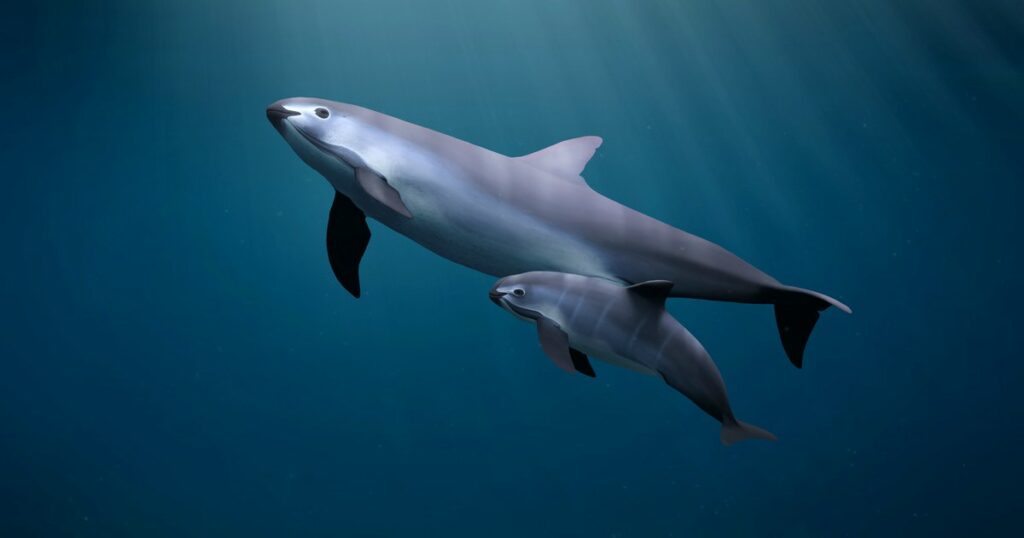
It has been a while since we posted a vaquita update here, and a fair amount has happened in Mexico’s Upper Gulf of California since then. Some of the news is good, and some of it is still worrying. We want to give you an honest picture of both.
What the 2025 survey found
Between May and September 2025, Mexico’s National Commission of Natural Protected Areas (CONANP) led the year’s vaquita survey. Scientists from the IUCN Cetacean Specialist Group worked on the design and analysis, observers searched from Sea Shepherd Conservation Society’s ships, and a network of underwater detectors listened for vaquita clicks. It closed out more than 8,000 days of acoustic research across the vaquita’s recent range, plus two ships searching for 28 days each.
Observers saw between 7 and 10 different vaquitas, and at least one of them was a calf. The detectors picked up vaquitas 93 times at 24 of the 66 listening sites. For comparison, the 2023 survey saw 8 to 13 animals and the 2024 survey saw 6 to 8, with no calves that year.
These numbers are a minimum count from a small search area, so they shouldn’t be read as the size of the whole population, and the scientists have been careful not to call a trend from three years of results. What they do tell us is that vaquitas are still alive in the Gulf, still feeding and still having calves. The researchers are now working through the 2025 data to produce a new population estimate, the first since 2018, and we will share it here when it is published.
Where the vaquitas are
Since 2017, most vaquita detections have come from the Zero Tolerance Area, a 225 km² stretch of water near San Felipe where all fishing is banned. The Mexican Navy has sunk concrete blocks fitted with hooks across it (193 in 2022 and another 216 in 2024) to snag illegal gillnets.
The 2025 survey added a complication. About a fifth of its sightings were outside the area protected by the blocks, and the vaquitas made heavy use of waters to the north-west that have no blocks at all.
2026: training the next survey team
The scientists agreed that 2026 should go to analysing the 2025 data, so there was no full survey this year. Instead, CONANP spent May training eight people from San Felipe as vaquita observers, with 22 hours of preparation on shore and 10 days at sea working beside experienced observers. The plan is for the strongest trainees to join the professional observers on the next full survey, set for spring 2027.
The weather was unusually rough for most of the campaign, with high swells and strong winds, and the team managed three short sightings. All three were outside the Zero Tolerance Area, one just past its edge and two in the unprotected waters to the north-west. The acoustic detectors confirmed vaquitas were still there, even though scallop fishers working the area cut several of them loose. Part of the team’s job was to find Frida, an adult female first seen in 2023 whose calf, photographed in 2025, was just over a year old. The weather didn’t give them the chance.
CONANP’s report on the campaign recommends laying concrete blocks with hooks in those north-western waters and calls it an urgent conservation priority, because vaquitas were found there in both September 2025 and May 2026. Gillnets set for totoaba, a large fish whose swim bladder sells for high prices on the black market, are still the one thing that could finish off the vaquita, and right now part of the vaquitas’ range has no physical protection against them.
Why we still have hope
A 2022 genetic study by Jacqueline Robinson and colleagues found that vaquitas have lived as a small population for tens of thousands of years, and that inbreeding is unlikely to doom them. In the study’s models, if gillnet deaths stop completely, the vaquita survives the next 50 years in 94 out of 100 simulations. Everything depends on keeping the nets out, including in the waters where the vaquitas have been spending more of their time.
Two ways to help this October
International Save the Vaquita Day is on Saturday, 10 October. As part of the VIVA Vaquita Coalition, the Porpoise Conservation Society runs the broadcast each year, and we will be on air with our friends from VIVA Vaquita, representatives of the Mexican government and other conservation groups. Expect presentations, live art and discussion, plus things you can do for the vaquita right away. You can watch live at , where recordings of past years are also available.
Save The Vaquita Week starts the next day and runs from Sunday, 11 October to Saturday, 17 October. Artist and streamer Kasey Snow started it in 2025 with a group of streamers who raised money and awareness for the vaquita on their channels. We are glad to support it again this year alongside the BC Marine Mammal Rescue Society. The schedule, the streamers taking part and the ways to donate are all at .
If you can’t watch live, sharing either event with someone who has never heard of the vaquita still helps.
Sources: